A capsule wardrobe is a small seasonal collection of clothing, shoes, and accessories chosen to work together. Start with what you own, keep pieces that suit your days and feel comfortable, then fill only the gaps you actually notice. The 30-piece checklist below is a starting formula: 9 tops, 5 bottoms, 4 layers, 2 one-pieces, 5 pairs of shoes, and 5 bags or accessories. Your useful number may be smaller or larger.
The 30-piece starting formula: 9 tops + 5 bottoms + 4 layers + 2 one-pieces + 5 shoes + 5 bags/accessories = 30 pieces. Nine tops paired with five bottoms create up to 45 starting combinations on paper; the real test is whether you enjoy wearing them.
What Is a Capsule Wardrobe (and What It Isn’t)
The idea associated with Susie Faux’s early capsule wardrobe is a compact foundation of adaptable clothes supplemented as needs and seasons change. Today, the useful principle is interchangeability: a clothing item earns space because it works with several others and fits a real part of your week. Stitch Fix’s capsule wardrobe guide also describes a small collection of versatile pieces worn in different combinations.
A capsule is not a requirement to own only 30 items, buy all new basics, or dress entirely in black and beige. Navy and cream are one easy base, but emerald, berry, terracotta, or another favorite color can belong if you like the combinations. For help choosing pairings from garments you already have, see how to match clothing colors.
The 5-Step Method to Build Your Capsule
Step 1: The Closet Audit (Keep, Store, Donate)
Pull together the clothes and shoes you use in the current season. Make three groups: keep within reach, store for another season or decision, and donate or repair. Ask when you last wore each piece, whether you can move comfortably in it, and what you would put with it tomorrow. Try on uncertain pieces before deciding. A garment can be attractive and still be wrong for your schedule or comfort; there is no need to discard it immediately.
Step 2: Define Your Lifestyle Reality
Estimate how you actually spend a typical week. If roughly 60% of your dressed time is remote work, 20% is walking or exercise, and 20% is social outings, your accessible clothes should support those uses in roughly similar proportions. This is a planning example, not a quota. Note weather, laundry frequency, workplace expectations, and how often you repeat outfits. A capsule built around an imagined formal life will leave everyday gaps.
Step 3: Select Your Base Color Palette
Choose two colors that can connect your most-used garments—navy and cream, for example—then add two supporting tones such as pale blue and cognac. Lay real clothes together in daylight. If a pair feels off, compare its depth and fabric texture before rejecting the colors. A wardrobe color palette guide is planned for a more detailed system; meanwhile, the clothing color combinations guide offers combinations you can test now.
Step 4: Fill the Gaps with Versatile Essentials
Make three or four outfits from your keep pile. Write down only the missing jobs: perhaps a layer that works over two tops, a comfortable shoe for your commute, or a bottom that pairs with several shirts. Look for a candidate that works with at least three pieces you already own. Check movement, care needs, and the weather where you live before adding it. Your best essential is the piece that solves a repeated dressing problem, not the item on a generic list.
Step 5: Test and Rotate Seasonally
Wear the capsule for a few weeks and note which outfits you reach for. Move clothes for a different climate or season out of the active area, then bring them back when needed. A quarterly check can be convenient, but you only need to change pieces when your weather, routine, or preferences change. Keep a small list of genuine gaps so a seasonal rotation does not become an automatic shopping trip.
The Complete 30-Piece Seasonal Checklist
Use this as a sample capsule, then swap categories to match your life. A uniform, religious dress, climate-specific gear, or favorite silhouette may call for a different allocation. Count each pair of shoes as one entry. The rail shows the coordination principle, not every item in the list.
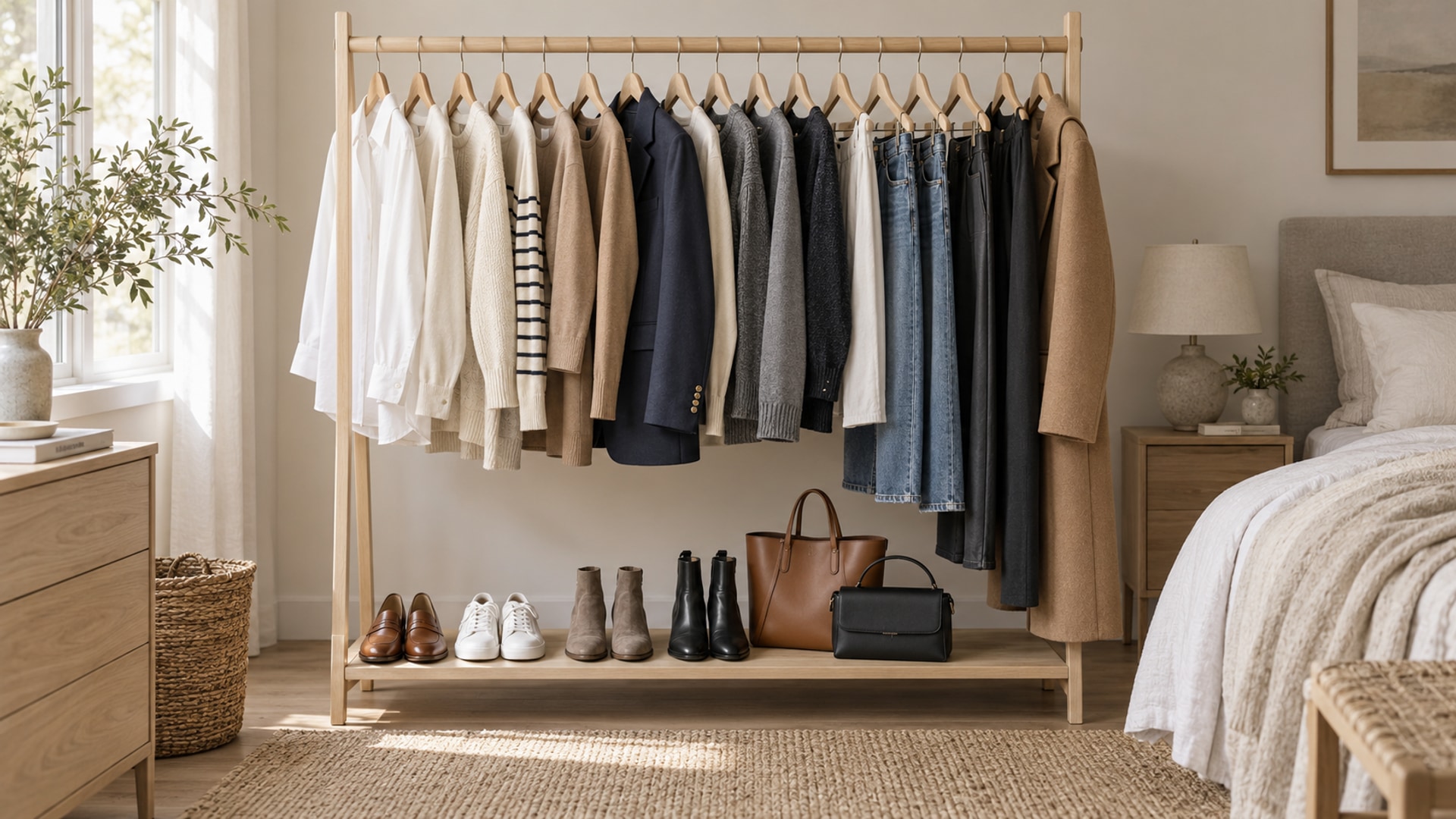
| Category | Count | Sample pieces |
|---|---|---|
| Tops | 9 | 3 T-shirts (white, black, stripe); 2 shirts (white Oxford, blue chambray); 2 lightweight knits; 1 silk blouse; 1 textured sweater |
| Bottoms | 5 | 2 jeans (dark straight, relaxed light); 1 pleated tailored trouser; 1 midi skirt; 1 wide-leg trouser or chino |
| Layers | 4 | 1 structured blazer; 1 trench coat; 1 denim or leather jacket; 1 button-front cardigan |
| Dresses and one-pieces | 2 | 1 daytime shirt dress; 1 versatile midi dress or another one-piece you would actually wear |
| Shoes | 5 | 1 white sneaker; 1 loafer; 1 ankle boot; 1 flat mule or ballet flat; 1 comfortable dressier shoe |
| Bags and accessories | 5 | 1 tote; 1 crossbody bag; 2 belts; 1 silk scarf |
| Total | 30 | Adapt the mix to your routine and season. |
The neutral examples are easy to coordinate, but none are mandatory. If you rarely wear dresses, replace them with two pieces that cover an unmet occasion. If a black belt is unnecessary, use that place for another accessory you wear. Start by checking what is already in your closet.
The Multiplication Formula: Turning 9 Tops and 5 Bottoms into 45 Outfits
The basic arithmetic is 9 tops × 5 bottoms = 45 possible top-and-bottom pairs. It is a way to spot versatility, not a promise that every pair will look or feel good. Try each candidate with the rest of your capsule: proportions, fabric weight, dress code, and personal taste may rule out some pairings.
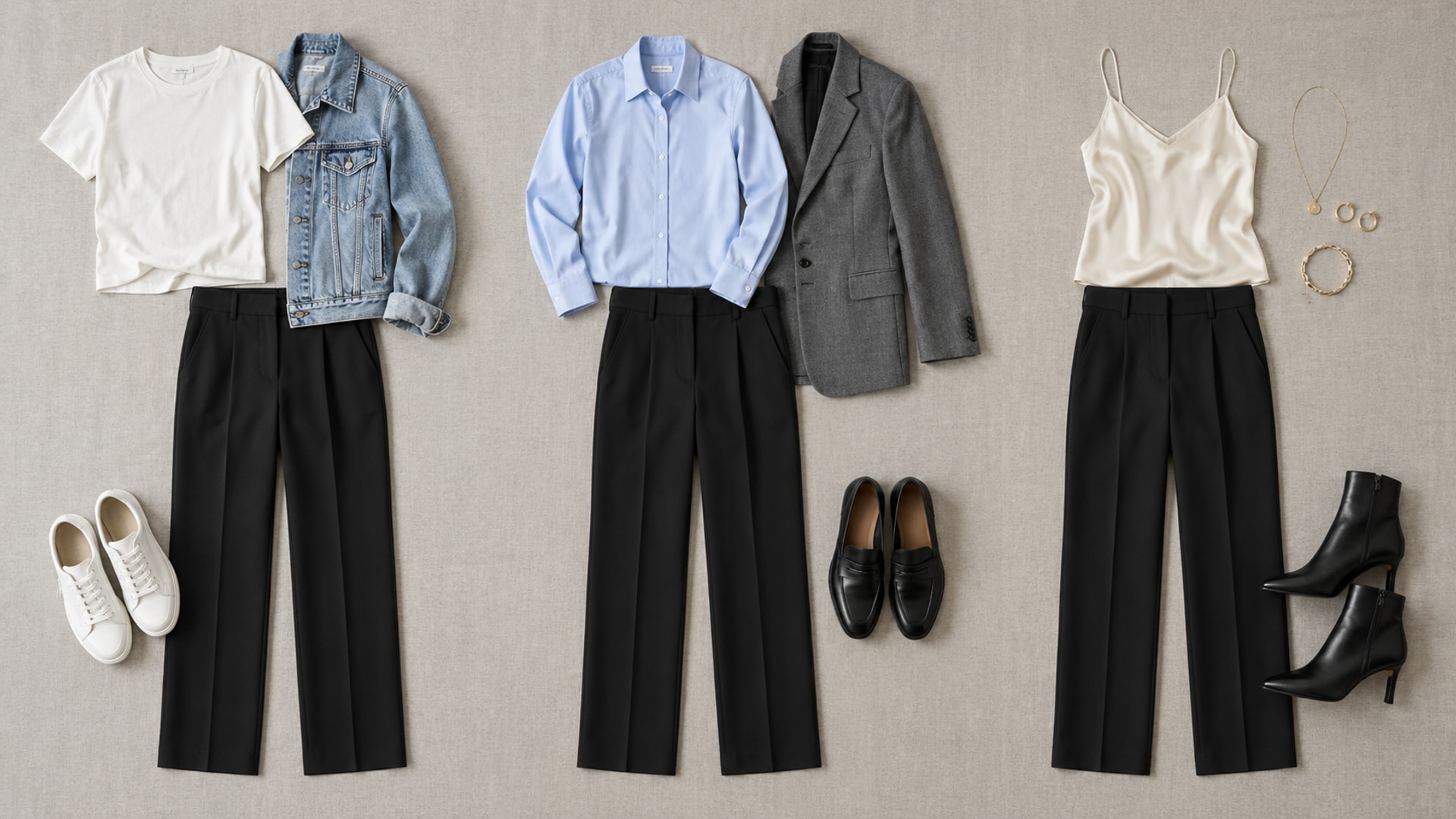
Now take one black straight-leg trouser: add an ivory tee, denim jacket, and sneakers for a casual day; a blue shirt, gray blazer, and loafers for work; or a silk camisole, simple jewelry, and ankle boots for dinner. A layer and a shoe change can make more variations from the same base. In theory, even a subset of the 45 pairs can produce more than 70 distinct combinations with layers or shoes; in practice, keep only the combinations that suit your life. Save a few reliable formulas, such as top + bottom + layer + shoe, where you can see them when getting dressed.
If you want a more personal starting point, the Outfit Test preview explains the planned photo-and-questionnaire recommendation experience. The guide above is complete to use on its own.
Frequently Asked Questions
Do I have to wear neutral colors for a capsule wardrobe?
No. Neutrals can connect several outfits, but a capsule can center on berry, emerald, terracotta, or any colors you enjoy. Compare actual garments together and keep the combinations you would wear.
How often should I change or update my capsule?
Review it when the season or your schedule changes. Four seasonal check-ins are convenient for some people, but there is no required percentage to replace. Rotate weather-specific pieces and update only the gaps you notice.
What is the Project 333 rule?
Project 333 is Courtney Carver’s challenge to dress with 33 items or fewer for three months, including clothing, outerwear, shoes, jewelry, and accessories. It is a separate experiment from this 30-piece sample, and you can try its time frame without adopting every rule permanently.
Explore Related Wardrobe Frameworks
For the next step, use clothing color combinations to make your pieces work together, or explore the Outfit Test preview for the planned personalized experience. More focused guides for a work capsule and travel capsule are part of this site’s upcoming wardrobe library.